IV Catheter Sizes Explained: Gauge, Color and Choosing the Right Size
IV catheters are available in several sizes, and understanding IV catheter gauge, diameter and typical applications can make purchasing IV supplies easier for healthcare facilities.
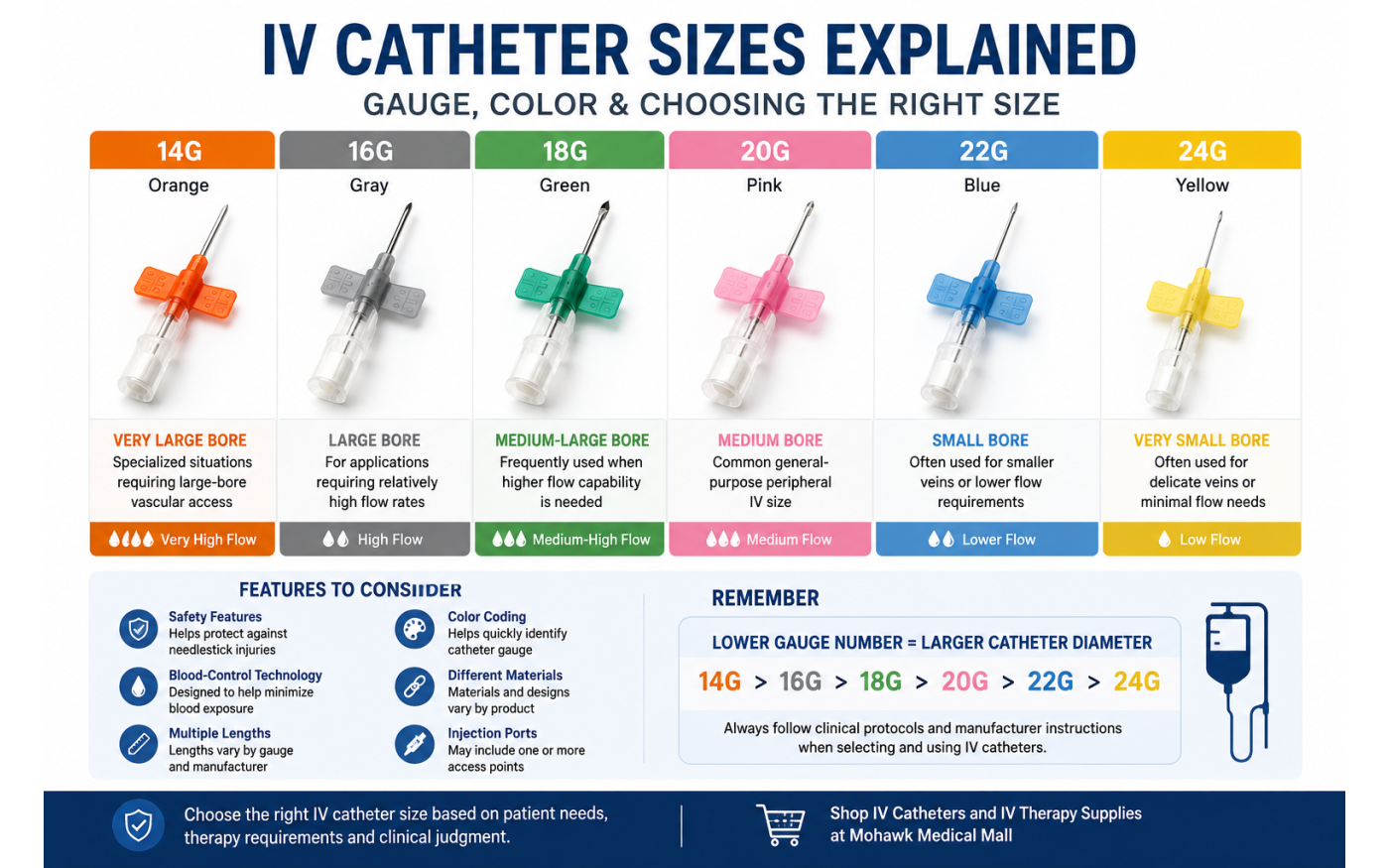
One of the most common points of confusion is the gauge system: the smaller the gauge number, the larger the catheter diameter. That means an 18-gauge IV catheter is larger than a 22-gauge catheter.
For IV therapy practices, wellness clinics, physician offices and other healthcare facilities, choosing which catheter sizes to stock depends on the patient population, prescribed therapy, clinical requirements and facility protocols.
This guide explains common IV catheter gauges, color coding and other features buyers should understand when comparing peripheral IV catheters.
What Is a Peripheral IV Catheter?
A peripheral intravenous catheter, commonly called a PIV catheter or IV catheter, is a short catheter inserted into a peripheral vein to establish vascular access.
Peripheral IV catheters are available in different gauges and lengths and may incorporate features such as:
- Integrated safety mechanisms
- Blood-control technology
- Different catheter materials
- Multiple catheter lengths
- Color-coded components
- Winged or non-winged designs
Exact specifications vary by manufacturer and product line.
Understanding IV Catheter Gauge
IV catheter size is commonly identified by gauge, abbreviated as "G."
An important rule to remember is:
A lower gauge number indicates a larger catheter diameter.
For example:
18G is larger than 20G
20G is larger than 22G
22G is larger than 24G
This can initially seem backwards, but it makes comparing catheter sizes much easier once you understand the gauge system.
Common IV Catheter Sizes
Some of the most commonly encountered peripheral IV catheter sizes include:
| IV Catheter Gauge | Relative Size | Common Considerations |
|---|---|---|
| 14G | Very large | Specialized situations requiring large-bore vascular access |
| 16G | Large | Applications requiring relatively high flow rates |
| 18G | Medium-large | Frequently used when higher flow capability is needed |
| 20G | Medium | Common general-purpose peripheral IV size |
| 22G | Small | Often considered when smaller veins or lower flow requirements are involved |
| 24G | Very small | Often used when vascular access requires a smaller catheter |
These are general descriptions rather than recommendations for a particular patient or procedure. Catheter selection should be based on clinical judgment, prescribed therapy, patient assessment, manufacturer instructions and facility protocols.
What Do IV Catheter Colors Mean?
Many peripheral IV catheter manufacturers use color coding to help healthcare professionals quickly identify catheter gauge.
Commonly encountered colors may include:
- 14G – Orange
- 16G – Gray
- 18G – Green
- 20G – Pink
- 22G – Blue
- 24G – Yellow
Color coding can provide a convenient visual reference, but purchasers and clinicians should always verify the gauge printed on the product packaging rather than relying solely on color.
Manufacturer specifications should be the final reference.
18 Gauge vs. 20 Gauge IV Catheters
Two commonly stocked sizes are 18G and 20G IV catheters.
An 18G catheter has a larger diameter than a 20G catheter and generally allows a higher potential flow rate when other variables are comparable.
A 20G catheter is a common general-purpose size in many healthcare environments.
The appropriate size depends on factors such as vein characteristics, therapy requirements, anticipated flow requirements and clinical protocol.
20 Gauge vs. 22 Gauge IV Catheters
Another common comparison is 20G vs. 22G.
The 22G catheter is smaller in diameter than the 20G catheter. A smaller catheter may be considered when vascular access is more challenging or when the intended therapy does not require the flow characteristics of a larger catheter.
Again, catheter size should be selected based on the individual clinical situation rather than gauge alone.
Does IV Catheter Length Matter?
Gauge isn't the only specification buyers should consider.
Catheter length can also vary.
Two IV catheters with the same gauge may be offered in different lengths. Manufacturers may provide multiple gauge-and-length combinations within the same catheter product family.
When comparing products, review both:
Gauge × Catheter Length
rather than assuming all catheters of the same gauge have identical dimensions.
What Is a Safety IV Catheter?
Many modern peripheral IV catheters incorporate a safety mechanism designed to help reduce accidental needlestick exposure after catheter insertion.
Depending on the product, the safety feature may shield or otherwise isolate the needle as it is withdrawn.
Manufacturers use different safety technologies, so facilities should evaluate the specific design and instructions for each product.
What Is a Blood-Control IV Catheter?
Some newer IV catheter systems incorporate blood-control technology.
These designs are intended to help limit blood exposure during insertion and connection procedures. The exact operation and benefits vary by manufacturer and catheter design.
For example, BD offers peripheral IV catheter families incorporating blood-control and safety technologies.
When comparing conventional and blood-control catheters, buyers should review the manufacturer's specifications carefully because features can vary even within the same product family.
What Should IV Therapy Practices Consider When Buying Catheters?
Rather than purchasing only one gauge, many healthcare facilities maintain an assortment of peripheral IV catheter sizes.
Factors to consider when building an IV catheter inventory include:
- Patient population
- Types of therapies provided
- Commonly used catheter gauges
- Catheter lengths
- Safety features
- Blood-control features
- Staff preferences and training
- Manufacturer compatibility and standardization
- Facility purchasing protocols
Standardizing around a smaller number of commonly used products can also simplify ordering and inventory management.
Other Supplies Used With IV Catheters
IV catheters are just one component of vascular access and IV therapy.
Depending on the procedure and facility, related supplies may include:
- IV start kits
- IV administration sets
- IV solution bags
- Saline flush syringes
- Tourniquets
- Alcohol prep pads
- Skin antisepsis products
- Gauze
- Transparent dressings
- Tape
- Gloves
- Sharps containers
Purchasing these supplies together can make it easier for IV therapy practices to maintain consistent inventory levels.
Shop IV Catheters and IV Therapy Supplies
Mohawk Medical Mall, backed by Mohawk Healthcare, supplies medical products and equipment to healthcare professionals and facilities throughout the United States.
Our IV therapy selection includes IV catheters, IV administration sets, IV bags, saline flushes, IV start kits, needles, syringes, sharps containers and other everyday IV supplies.
Mohawk Healthcare has served healthcare customers since 1946, providing the experience of an established medical-surgical distributor combined with convenient online ordering through Mohawk Medical Mall.
Frequently Asked Questions About IV Catheter Sizes
What are the most common IV catheter sizes?
Peripheral IV catheters are commonly available in gauges including 14G, 16G, 18G, 20G, 22G and 24G. Availability varies by manufacturer and product family.
Is an 18G or 20G IV catheter bigger?
An 18G IV catheter is larger in diameter than a 20G catheter. With catheter gauges, a lower gauge number indicates a larger diameter.
Is a 20G or 22G IV catheter bigger?
A 20G catheter is larger in diameter than a 22G catheter.
What color is a 20 gauge IV catheter?
20G peripheral IV catheters are commonly associated with pink color coding. Always verify the gauge on the manufacturer's labeling rather than relying solely on color.
What color is a 22 gauge IV catheter?
22G peripheral IV catheters are commonly associated with blue color coding. Confirm the actual product gauge on its packaging.
What does the G mean in 20G IV catheter?
The "G" stands for gauge, which is the sizing system used to identify the diameter of the catheter.
Are all IV catheters the same length?
No. Peripheral IV catheters are available in different lengths, including different lengths within the same gauge. Buyers should verify both gauge and catheter length when selecting a product.
What is a safety IV catheter?
A safety IV catheter incorporates a mechanism designed to help protect against accidental needlestick exposure after catheter insertion. Safety mechanisms vary by manufacturer and product.
Shop IV Therapy Supplies
Mohawk Medical Mall offers a wide selection of IV therapy products, including:
- IV Bags
- Normal Saline IV Bags 1000ML
- Lactated Ringer's IV Bags 1000ML
- IV Administration Sets
- Saline Flush Syringes
- IV Start Kits
Explore our IV Therapy collection to find products from trusted healthcare manufacturers.
Related IV Therapy Resources
To learn more about IV therapy, explore these educational guides:
- The Complete Guide to IV Therapy Supplies
- IV Bag Sizes Explained: Choosing the Right IV Bag for Every Application
- Now Stocking IV Bags from BD, B. Braun & Baxter — With Fast Shipping and Easy RX Setup
- Normal Saline vs. Lactated Ringer's: What's the Difference?
- How to Reduce Waste and Save Money on IV Therapy Supplies
- IV Administration Sets Explained: How to Choose the Right IV Tubing
- How to Choose the Right IV Administration Set for Your Practice
- IV Catheter Sizes Explained | Gauge & Color Guide