IV Administration Sets Explained: How to Choose the Right IV Tubing
Choosing the right IV administration set is an important part of setting up an efficient IV therapy program. While IV bags and catheters often receive most of the attention, the administration set—or IV tubing—is the connection that allows fluid to travel from the IV solution container to the patient's vascular access device.
IV administration sets are available in different configurations, including varying drop factors, tubing lengths, injection sites, connectors and flow-control features. Understanding these differences can help healthcare professionals select supplies appropriate for their equipment, procedures and facility protocols.
Whether you're purchasing supplies for an IV hydration clinic, wellness practice, physician office or other healthcare setting, this guide explains some of the most important features to consider when comparing IV administration sets.
What Is an IV Administration Set?
An IV administration set is sterile tubing designed to transfer fluid from an IV bag or other compatible solution container to the patient's vascular access device.
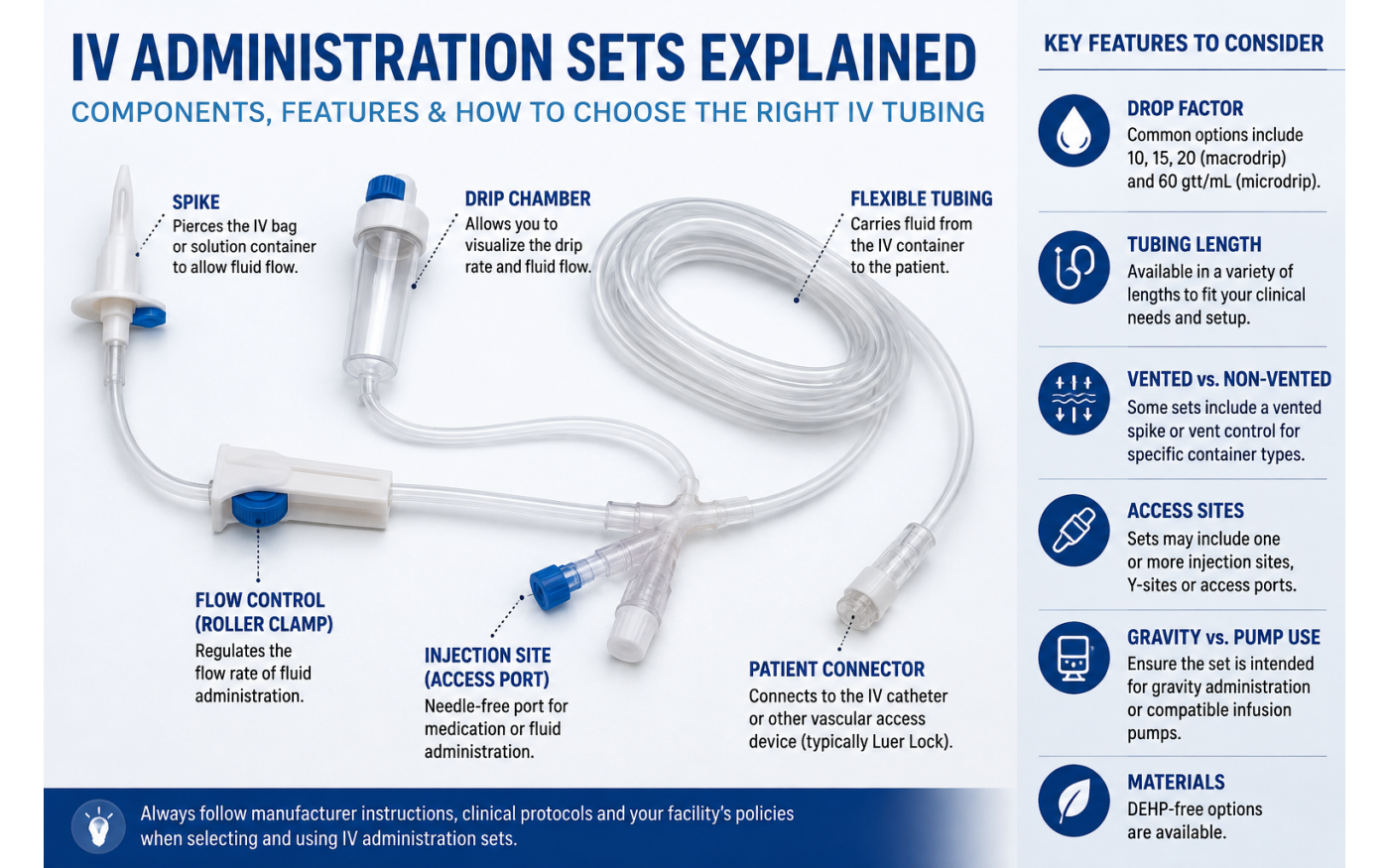
A typical administration set may include:
- A spike for accessing the IV solution container
- A drip chamber
- Flexible tubing
- A roller clamp or other flow-control mechanism
- One or more injection or access sites
- A patient-side connector
Exact configurations vary by manufacturer and product.
Because administration sets are available in many different designs, buyers should review the manufacturer's specifications rather than assuming that all IV tubing is interchangeable.
Primary vs. Secondary IV Administration Sets
One of the first distinctions buyers may encounter is primary versus secondary administration sets.
Primary IV Sets
Primary administration sets are generally used as the main tubing between an IV solution container and the patient's vascular access device.
These sets may be used for continuous or intermittent fluid administration depending on the product, equipment and clinical protocol.
Secondary IV Sets
Secondary administration sets are designed for use in compatible secondary or piggyback applications.
They typically connect a secondary solution container to an existing primary administration system.
When purchasing either type, verify compatibility with the other components and equipment being used.
Understanding IV Tubing Drop Factor
One of the most important specifications on an IV administration set is its drop factor, usually expressed as drops per milliliter (gtt/mL).
Common configurations include both macrodrip and microdrip administration sets.
Macrodrip IV Sets
Macrodrip sets deliver larger drops and are available in several drop factors.
Depending on the manufacturer and product, common configurations can include:
- 10 gtt/mL
- 15 gtt/mL
- 20 gtt/mL
Always verify the stated drop factor on the individual product before use.
Microdrip IV Sets
Microdrip tubing commonly has a drop factor of:
60 gtt/mL
The appropriate drop factor depends on the intended application, method of administration, equipment and clinical protocol.
Gravity IV Sets vs. Pump-Compatible Sets
Another important consideration is how the IV solution will be delivered.
Some administration sets are designed for gravity administration, while others are manufactured for use with specific infusion pumps or infusion systems.
These products should not automatically be considered interchangeable.
When purchasing tubing for an infusion pump, verify that the administration set is specifically compatible with the pump or system being used.
For gravity applications, buyers should review specifications such as drop factor, tubing length, connectors, injection sites and flow-control components.
Vented vs. Non-Vented IV Tubing
Some IV administration sets include a vented spike or another venting feature.
Whether a vent is required depends partly on the type of solution container being accessed.
Flexible IV bags generally collapse as fluid leaves the container and typically do not require air to enter the bag to replace the displaced solution. Certain rigid or semi-rigid containers may require a vented configuration.
Some administration sets incorporate a vent that can be opened or closed depending on the application.
Always follow the administration set and solution-container manufacturer's instructions.
Needle-Free Injection Sites and Y-Sites
IV administration sets may include one or more access points along the tubing.
Depending on the product, these may include:
- Needle-free access sites
- Y-sites
- Injection sites
- Luer access points
The number and location of these sites can be an important purchasing consideration, particularly for facilities trying to standardize their IV supply inventory.
Compare the complete configuration of the set rather than purchasing based solely on tubing length or drop factor.
What Does DEHP-Free IV Tubing Mean?
Buyers may also encounter administration sets marketed as DEHP-free.
DEHP is a plasticizer historically used in some PVC medical tubing and other plastic products. Manufacturers now offer numerous IV administration sets manufactured without DEHP.
If DEHP-free construction is important to your facility, verify the manufacturer's specifications for the individual administration set rather than assuming an entire product line has the same material composition.
How Long Is IV Administration Tubing?
IV administration sets are available in a variety of tubing lengths.
The appropriate length depends on the treatment environment, equipment placement and intended use.
A longer set may provide additional flexibility between the IV solution and patient, while a shorter configuration may be preferable in other environments.
Because tubing length can vary substantially between products, it should be included when comparing administration sets from different manufacturers.
How to Choose an IV Administration Set
When evaluating IV tubing, consider the complete configuration rather than focusing on a single specification.
Important questions include:
- Is the set intended for gravity administration or an infusion pump?
- What is the drop factor?
- Is the tubing vented, non-vented or configurable?
- What is the tubing length?
- How many injection or access sites are included?
- What type of patient connector is provided?
- Is the tubing DEHP-free if that is required?
- Is the set compatible with the IV solution container and equipment being used?
Healthcare facilities should always follow manufacturer instructions, applicable clinical protocols and organizational policies when selecting and using IV administration products.
Building a Complete IV Therapy Supply Inventory
IV administration tubing is only one component of an IV therapy setup.
Depending on the services provided, facilities may also purchase:
- IV solution bags
- IV catheters
- Saline flush syringes
- IV start kits
- Needles and syringes
- Alcohol prep pads and skin preparation products
- Gauze
- Tourniquets
- Sharps Containers
- Gloves
Standardizing commonly used supplies can also simplify purchasing and inventory management for busy IV therapy and wellness practices.
Shop IV Therapy Supplies from Mohawk Medical Mall
Mohawk Medical Mall, backed by Mohawk Healthcare, provides medical supplies and equipment for healthcare professionals, facilities and practices across the United States.
Our IV therapy selection includes administration sets, IV bags, catheters, saline flushes, injection supplies, sharps disposal products and other everyday supplies used by healthcare providers.
Mohawk Healthcare has served healthcare customers since 1946, combining established medical-supply distribution experience with convenient online ordering through Mohawk Medical Mall.
Frequently Asked Questions About IV Administration Sets
What is an IV administration set?
An IV administration set is sterile tubing used to transfer fluid from an IV solution container to a compatible vascular access device. Configuration varies by product and manufacturer.
What does gtt/mL mean on IV tubing?
Gtt/mL means drops per milliliter and describes the administration set's drop factor. Common sets may have drop factors such as 10, 15, 20 or 60 gtt/mL.
What is the difference between macrodrip and microdrip tubing?
Macrodrip sets produce larger drops and are available in several drop factors. Microdrip administration sets commonly use a 60 gtt/mL configuration. Product specifications should always be verified before use.
Can any IV tubing be used with an infusion pump?
No. Administration sets intended for infusion pumps should be verified for compatibility with the specific pump or infusion system.
Do IV bags require vented tubing?
Flexible IV bags generally collapse as fluid leaves the container and typically do not require air to replace the displaced solution. Requirements may differ for other container types, so users should follow manufacturer instructions.
Are all IV administration sets the same?
No. Administration sets can differ in drop factor, tubing length, venting, access sites, connectors, materials and compatibility with infusion equipment.
Related IV Therapy Resources
To learn more about IV therapy, explore these educational guides:
- The Complete Guide to IV Therapy Supplies
- IV Bag Sizes Explained: Choosing the Right IV Bag for Every Application
- Now Stocking IV Bags from BD, B. Braun & Baxter — With Fast Shipping and Easy RX Setup
- Normal Saline vs. Lactated Ringer's: What's the Difference?
- How to Reduce Waste and Save Money on IV Therapy Supplies
- IV Administration Sets Explained: How to Choose the Right IV Tubing
- How to Choose the Right IV Administration Set for Your Practice
- IV Catheter Sizes Explained | Gauge & Color Guide