How to Clean a Tuttnauer Autoclave
Regular cleaning and maintenance are important parts of owning a Tuttnauer autoclave. Steam sterilizers are repeatedly exposed to water, heat, minerals and instrument-processing residue, making routine cleaning necessary to keep the chamber, reservoir and other components in proper condition.
However, not every Tuttnauer autoclave is cleaned the same way.
Traditional models such as the Tuttnauer 1730 Valueklave, 2340M and 2540M have different cleaning procedures from newer automatic sterilizers such as the Tuttnauer T-TOP Series. The correct cleaning product and procedure should always be based on the specific sterilizer model and its current operating manual.
This guide explains common Tuttnauer autoclave maintenance practices, how Chamber Brite autoclave cleaner is used with compatible sterilizers, how T-TOP cleaning differs, the importance of distilled water, and when additional service may be required.
Important: This guide is intended as a general reference. Always follow the current Tuttnauer operating and maintenance manual for your specific autoclave model.
Why Is Autoclave Cleaning Important?
A steam sterilizer operates under demanding conditions. Water is repeatedly heated inside the unit, while minerals, residue and other contaminants can accumulate over time.
Tuttnauer warns that if an autoclave isn't cleaned regularly, dirt and debris can accumulate and potentially clog tubing and valves. The manufacturer also notes that deposits inside the stainless-steel chamber can trap moisture against the chamber surface.
Routine cleaning can help remove:
- Hard-water deposits
- Mineral buildup
- Oxides
- Sediment
- Dirt and debris
- Residue inside the chamber
- Deposits within compatible reservoirs and tubing
Cleaning should be considered part of a broader preventative-maintenance program rather than something performed only when the sterilizer develops a problem.
How Often Should You Clean a Tuttnauer Autoclave?
The appropriate cleaning frequency depends on the model and how frequently the sterilizer is used.
Tuttnauer's general FAQ recommends more frequent cleaning as sterilizer use increases. As an example, Tuttnauer states that a sterilizer averaging approximately 20 cycles per week should be cleaned weekly, while one used only once or twice per week may require cleaning only about once per month.
Tuttnauer's Chamber Brite instructions recommend cleaning compatible autoclaves approximately:
Every 20 cycles or once per week as needed.
Those are general recommendations. Always follow the maintenance schedule specified in the operating manual for your particular model.
What Is Tuttnauer Chamber Brite?
Tuttnauer Chamber Brite is a powdered autoclave cleaner and descaler formulated for compatible steam sterilizers.
It is designed to remove water deposits, oxides and other sediment while cleaning and descaling the chamber, reservoir and tubing of compatible autoclaves.
Unlike a general-purpose household cleaner, Chamber Brite is specifically formulated for steam-sterilizer maintenance.
Shop Tuttnauer Chamber Brite Autoclave Cleaner
Which Tuttnauer Autoclaves Use Chamber Brite?
Chamber Brite is associated particularly with Tuttnauer's traditional tabletop sterilizers.
Tuttnauer's published instructions specifically identify different Chamber Brite quantities for models including:
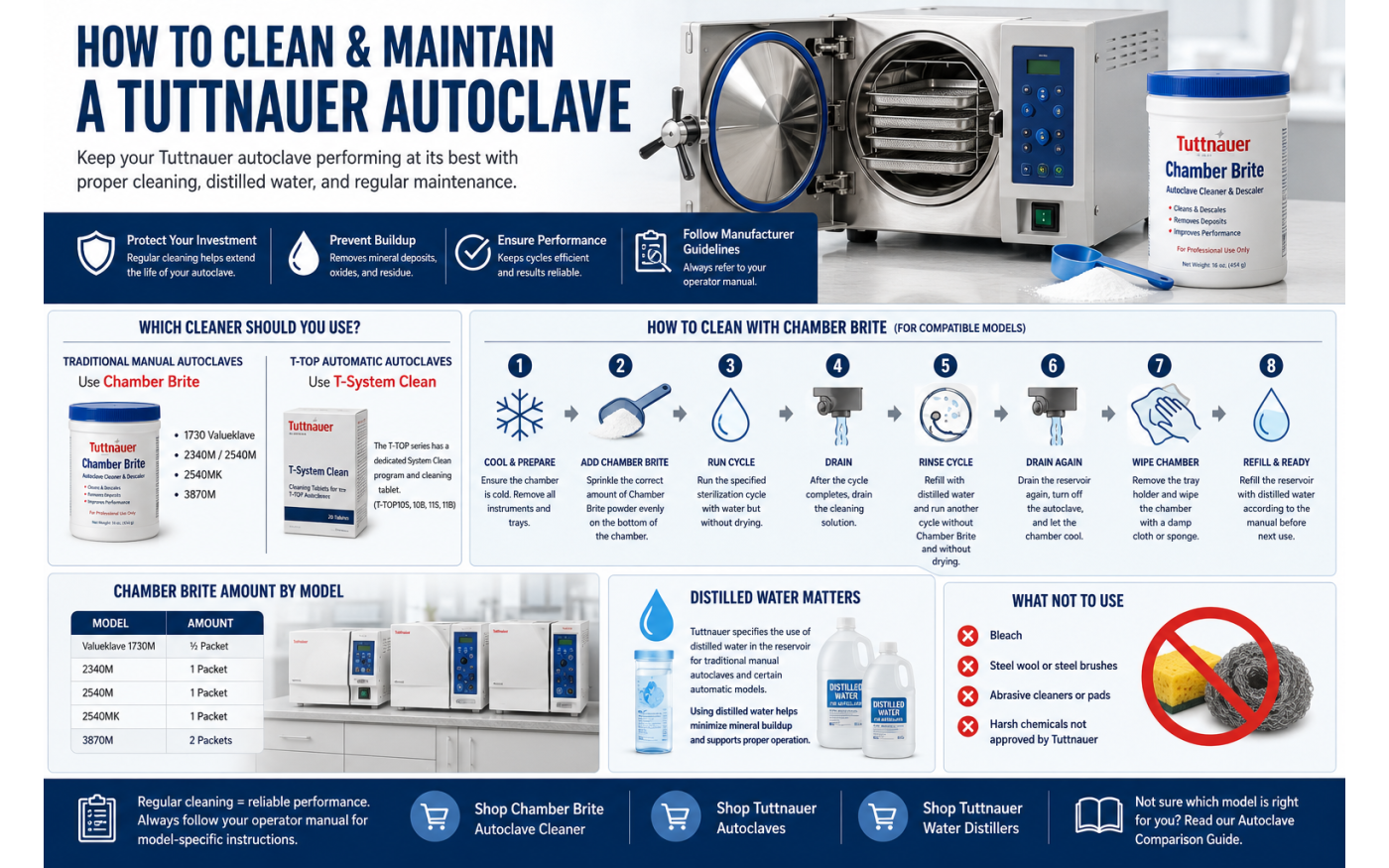
| Tuttnauer Model | Chamber Brite Amount |
|---|---|
| Valueklave 1730M | ½ packet |
| 2340M | 1 packet |
| 2540M | 1 packet |
| 2540MK | 1 packet |
| 3870M | 2 packets |
Tuttnauer's published manual-autoclave cleaning instructions specify these model-dependent amounts.
This is why you should not assume one packet is appropriate for every Tuttnauer autoclave.
The amount and procedure should always be verified against the current instructions for your specific model.
How to Clean a Tuttnauer Autoclave With Chamber Brite
Tuttnauer provides a defined Chamber Brite cleaning process for compatible sterilizers.
The manufacturer's general procedure can be summarized as follows:
1. Allow the Autoclave to Cool
The autoclave chamber should be cold before beginning the Chamber Brite cleaning procedure.
Remove all instruments and trays from the sterilizer.
2. Add the Correct Amount of Chamber Brite
Sprinkle the appropriate amount of Chamber Brite powder evenly along the bottom of the cold chamber.
The amount varies by sterilizer model, so consult the instructions for your specific unit.
3. Run a Sterilization Cycle Without Drying
Run the specified sterilization cycle with water but without a drying cycle.
4. Drain the Reservoir
After the cleaning cycle is complete, drain the cleaning solution from the reservoir according to the sterilizer's instructions.
5. Run a Rinse Cycle
Refill the reservoir with distilled water and run another sterilization cycle without Chamber Brite and without drying.
This helps flush remaining cleaner and loosened residue from the system.
6. Drain and Cool the Sterilizer
Drain the reservoir again, turn off the autoclave and allow the chamber to cool.
7. Wipe the Chamber
Remove the tray holder and wipe the inside of the chamber with a damp cloth or sponge.
8. Refill With Distilled Water
Refill the reservoir with distilled water according to the sterilizer's instructions before returning the unit to normal operation.
Tuttnauer's full Chamber Brite instructions should be followed rather than relying solely on this summary.
Cleaning the Tuttnauer 1730 Valueklave
The Tuttnauer 1730 Valueklave is one of the manufacturer's traditional manual tabletop autoclaves.
For Chamber Brite cleaning, Tuttnauer's published instructions specify one-half packet of Chamber Brite for the Valueklave 1730M.
Because the amount differs from larger manual autoclaves, owners should avoid assuming that a full packet should automatically be used.
In addition to routine chamber cleaning, follow the 1730 operating manual for reservoir, water sensor, door gasket and other scheduled maintenance requirements.
Shop the Tuttnauer 1730 Valueklave
Cleaning the Tuttnauer 2340M
The Tuttnauer 2340M is a 19-liter manual tabletop autoclave and one of Tuttnauer's established sterilizer models.
Tuttnauer specifies one packet of Chamber Brite when cleaning the 2340M.
The general Chamber Brite procedure includes cleaning the cold chamber, running the appropriate no-dry cleaning cycle, draining the system, performing a rinse cycle and wiping the chamber after it has cooled.
Shop the Tuttnauer 2340M Autoclave
Cleaning the Tuttnauer 2540M
The larger Tuttnauer 2540M is another manual tabletop autoclave compatible with Tuttnauer's published Chamber Brite cleaning procedure.
Tuttnauer specifies one packet of Chamber Brite for the 2540M.
As with the 2340M, Chamber Brite cleaning is only one component of maintaining the sterilizer. Additional inspection and preventative-maintenance procedures should be performed according to the 2540M operating manual.
Shop the Tuttnauer 2540M Autoclave
T-TOP Autoclave Cleaning Is Different
Do not simply copy the Chamber Brite procedure used for the 1730, 2340M or 2540M and apply it to a T-TOP sterilizer.
Tuttnauer's current T-TOP user manual specifies a dedicated System Clean cleaning procedure.
The procedure uses a T-System Clean tablet placed into the clean-water reservoir, after which the user selects the sterilizer's System Clean program. Tuttnauer states that the process cleans the chamber and piping and lasts approximately 25 minutes.
After the cycle, Tuttnauer's instructions include emptying the clean- and waste-water reservoirs, wiping the reservoirs and chamber as directed, refilling with distilled water, and running an Unwrapped Instrument cycle before returning the tray holder and trays to the chamber.
This applies to the T-TOP family, including models such as:
Compare Tuttnauer T-TOP Autoclaves
Check out our other articles to learn more about Autoclaves:
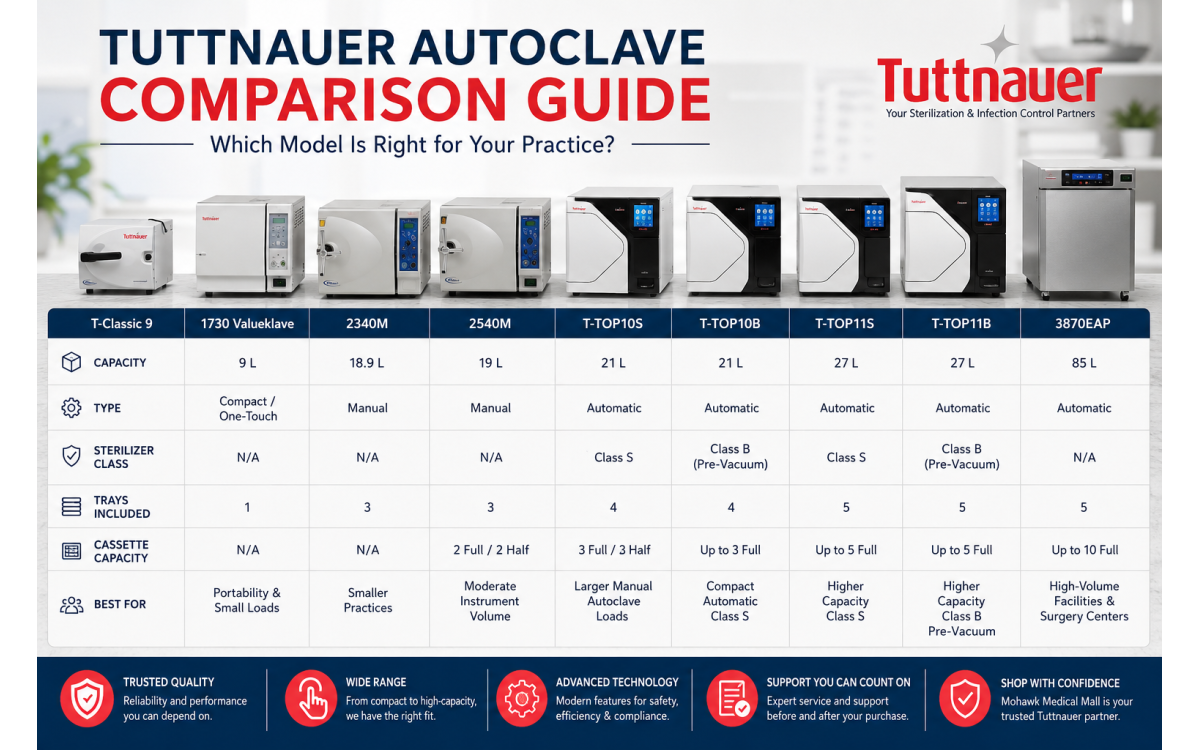
Tuttnauer Autoclave Comparison Guide: Which Model Is Right for Your Practice?
Autoclave Classes Explained: Class B vs. Class S vs. Gravity Sterilizers
Understanding Autoclave Testing: Why It Matters and How It's Performed
Where Can I Buy an Autoclave Online for a Medical Office?
Chamber Brite vs. T-System Clean
It's helpful to think of these as different Tuttnauer maintenance products for different sterilizer platforms.
| Product | Typical Application |
|---|---|
| Chamber Brite | Compatible traditional/manual Tuttnauer autoclaves |
| T-System Clean | Tuttnauer T-TOP sterilizers |
Chamber Brite is a cleaning and descaling powder used according to the procedure specified for compatible steam sterilizers. Tuttnauer categorizes it as a Class S chamber-cleaning powder in its current cleaning-materials catalog.
T-System Clean uses a dedicated tablet and System Clean program for the T-TOP family.
Always verify the correct cleaning product and procedure for your exact model.
What Should You NOT Use to Clean a Tuttnauer Autoclave?
Using the wrong cleaning method can damage the sterilizer.
Tuttnauer's manual-autoclave maintenance instructions specifically warn against using bleach, steel wool, steel brushes or abrasive materials to clean the chamber.
Instead, follow the manufacturer's procedure and use appropriate cleaning materials.
In particular:
- Don't use bleach unless specifically directed by the manufacturer for a particular application.
- Don't scrub the chamber with steel wool.
- Don't use steel brushes.
- Don't use abrasive materials that can damage stainless steel.
- Don't substitute an unapproved chemical cleaner simply because it removes mineral deposits.
- Don't assume a cleaning product intended for one Tuttnauer platform is appropriate for another.
When in doubt, check the current operating manual before putting any chemical into the chamber or reservoir.
Why Distilled Water Matters
Water quality plays an important role in autoclave operation and maintenance.
Tuttnauer's installation instructions for its traditional manual tabletop sterilizers specifically direct users to fill the reservoir with distilled water.
Minerals found in ordinary tap water can contribute to deposits inside equipment. Using the water specified by the manufacturer helps minimize unnecessary mineral accumulation and supports proper operation.
Water requirements can differ by model, so always follow the current instructions for your specific sterilizer.
Should You Use Tap Water in a Tuttnauer Autoclave?
For Tuttnauer models whose instructions specify distilled water, use distilled water rather than ordinary tap water.
Tuttnauer's current installation guidance for manual and certain automatic tabletop sterilizers directs users to fill their reservoirs with distilled water.
Facilities that use significant quantities of distilled water may also want to consider producing it on-site.
Shop Tuttnauer Water Distillers
Cleaning the Autoclave Water Sensor
Some Tuttnauer models also require routine cleaning of the water sensor.
Tuttnauer's current Valueklave manual, for example, specifies that the water sensor should be cleaned at least once per week. The manufacturer directs users to clean the sensor with a damp cloth or sponge, with a mild soapy solution if needed, while cleaning both the sides and tip to remove accumulated dirt or debris.
Again, maintenance schedules vary by model. Consult your sterilizer's manual to determine which components require regular cleaning.
Clean the Trays & Tray Holder Too
Autoclave maintenance shouldn't focus exclusively on the chamber.
Trays and tray holders should also be cleaned according to the manufacturer's instructions.
For the T-TOP System Clean procedure, for example, Tuttnauer instructs users to remove the instruments, trays and tray holder before the cleaning cycle and separately clean the trays and holder with an appropriate stainless-steel-safe cleaner.
Keeping removable components clean helps prevent residue from simply being reintroduced into a freshly cleaned chamber.
Don't Overload Your Autoclave
Maintenance isn't only about cleaning products.
Proper loading is also important to autoclave operation.
Tuttnauer notes in its troubleshooting guidance that overloading the sterilizer can contribute to operating problems and directs users to follow the operator's manual for proper loading instructions.
Don't exceed the loading recommendations for your particular model just to reduce the number of cycles being run.
Correct loading helps steam reach the surfaces intended for sterilization and allows the sterilizer to operate according to its designed cycle parameters.
Cleaning Does Not Replace Preventative Maintenance
Routine chamber cleaning is important, but it isn't the same thing as preventative maintenance or equipment service.
An autoclave contains components that may require periodic inspection, replacement or professional service according to the manufacturer's schedule.
Depending on the model, maintenance can involve components such as:
- Door gaskets
- Water sensors
- Air jets
- Filters
- Reservoirs
- Valves
- Tubing
- Safety systems
- Other model-specific wear components
Tuttnauer maintains operating manuals and preventative-maintenance resources for its tabletop sterilizers.
Follow the preventative-maintenance schedule specified for your particular autoclave rather than treating chamber cleaning as a substitute for equipment service.
When Should You Call for Autoclave Service?
Routine cleaning can address normal deposits and residue, but it shouldn't be used to mask a mechanical or operational problem.
Professional service may be appropriate when an autoclave:
- Repeatedly displays error messages
- Doesn't reach the required pressure or temperature
- Develops persistent leaks
- Has difficulty filling or draining
- Shows unusual cycle behavior
- Continues to have performance problems after proper cleaning
- Has reached a scheduled preventative-maintenance interval
If a sterilizer isn't operating correctly, follow the manufacturer's troubleshooting guidance or contact an appropriately qualified service provider.
A Simple Tuttnauer Autoclave Maintenance Routine
Rather than waiting until buildup becomes obvious, establish a repeatable maintenance schedule.
A good general approach is to:
Before/throughout use: Keep the chamber and loading area free of unnecessary debris and follow proper loading procedures.
On the manufacturer's recommended cleaning schedule: Clean the sterilizer using the correct product and procedure for the model.
Regularly: Inspect and clean model-specific components such as trays, tray holders, reservoirs and water sensors according to the operator manual.
At scheduled intervals: Complete required preventative maintenance and replace wear components as specified by Tuttnauer.
Always: Use the water quality required for the particular sterilizer.
The exact schedule should come from the current operating manual for your model.
Shop Tuttnauer Autoclaves & Maintenance Supplies
Mohawk Medical Mall offers Tuttnauer autoclaves, Chamber Brite autoclave cleaner, water distillers and sterilization equipment for medical, dental, veterinary and other professional healthcare environments.
Whether you're maintaining an existing Tuttnauer sterilizer or comparing replacement equipment, selecting the correct products for your specific autoclave model is important.
Shop Tuttnauer Chamber Brite Autoclave Cleaner
Shop Tuttnauer Autoclaves & Steam Sterilizers
Shop Tuttnauer Water Distillers
Shop All Tuttnauer Products
Not Sure Which Tuttnauer Autoclave Is Right for Your Practice?
If you're researching a replacement sterilizer, we've also created a detailed guide comparing Tuttnauer chamber sizes, manual vs. automatic operation, Class S vs. Class B sterilization and popular models.
Read: Tuttnauer Autoclave Comparison Guide – Which Model Is Right for Your Practice?
Frequently Asked Questions About Tuttnauer Autoclave Maintenance
How often should I clean my Tuttnauer autoclave?
Cleaning frequency depends on usage and model. Tuttnauer recommends Chamber Brite cleaning for compatible units approximately every 20 cycles or weekly as needed. Tuttnauer also notes that less frequently used sterilizers may require less frequent cleaning.
What should I use to clean a Tuttnauer autoclave?
It depends on the model. Chamber Brite is designed for cleaning and descaling compatible steam sterilizers, while the T-TOP family uses Tuttnauer's T-System Clean procedure and product. Always follow the current operating manual for your exact model.
How much Chamber Brite should I use in a Tuttnauer 1730?
Tuttnauer's published cleaning instructions specify one-half packet of Chamber Brite for the Valueklave 1730M.
How much Chamber Brite should I use in a Tuttnauer 2340M?
Tuttnauer specifies one packet of Chamber Brite for the 2340M.
How much Chamber Brite should I use in a Tuttnauer 2540M?
Tuttnauer specifies one packet of Chamber Brite for the 2540M.
Can I use Chamber Brite in a Tuttnauer T-TOP?
Follow the T-TOP's own cleaning procedure rather than assuming the Chamber Brite procedure used for traditional manual models applies. Tuttnauer's current T-TOP manual specifies T-System Clean and a dedicated System Clean program.
Can I use bleach to clean my Tuttnauer autoclave?
Tuttnauer's traditional tabletop-autoclave cleaning instructions specifically warn not to use bleach to clean the chamber. They also warn against steel wool, steel brushes and abrasive cleaning materials.
Should I use distilled water in my Tuttnauer autoclave?
Tuttnauer specifies distilled water for the reservoir of its traditional manual tabletop sterilizers and in its installation guidance for certain automatic units. Always verify the water requirements in the operating manual for your particular model.
Does cleaning an autoclave replace preventative maintenance?
No. Routine cleaning removes deposits, residue and debris, but preventative maintenance can include inspection or replacement of model-specific components. Follow the maintenance schedule in the operating manual for your sterilizer.
Where can I buy Tuttnauer Chamber Brite?
Mohawk Medical Mall offers Tuttnauer Chamber Brite Autoclave Cleaner along with Tuttnauer autoclaves, water distillers and related sterilization products.